How to Identify Deer Tracks From Other Similar Footprints
By Jason Knight
Have you ever needed to identify deer tracks?
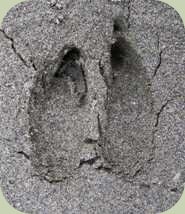
If you are in an area where deer are the only hoofed mammal, identifying their tracks from other species can be quite straightforward. Their tracks have two toes (hooves), that make an upside-down heart-shaped track. The photo to the right is an example of a typical deer track.
Many areas in North America contain additional hoofed mammals with similar sized tracks, such as pronghorn antelope or mountain goat. In these areas, differentiating the tracks of deer from tracks of other species can be much more difficult.
The illustrations and track characteristics listed below highlight a few key features that can be used to identify the tracks of deer from other hoofed mammals within the same size range.
Deer Tracks:
|
Deer (Odocoileus spp.) - The track has an upside-down heart shape. - The sides of the track are convex. - The front tips of the hooves are located towards the inside of the track. |
 |
Similar Species:
|
Pronghorn Antelope (Antilocapra americana) - The track also has an upside-down heart shape. - The sides of the track are concave (rather than convex). - The front tips of the hooves are also located towards the inside of the track. |
 |
|
Mountain Goat (Oreamnos americanus) - The overall track shape is blocky. - The front tips of the hooves are centered within each half of the foot. - The front tips of the hooves are wider and more rounded than the tips of deer and antelope tracks. |
 |
|
Bighorn Sheep (Ovis canadensis) - The overall track is wedge-shaped. - The front tips of the hooves are more pointed than mountain goat tracks, yet less pointed than deer tracks. - The sides of the track are straight. |
 |
|
Wild Boar (Sus scrofa) - The overall shape of the tracks is wide and rounded. - The tips of the hooves are blunt. - Dewclaws frequently register behind the track (not shown in drawing). |
 |
Differentiating hoofed mammal tracks between the different species can be quite challenging, especially when in terrain lacking clear substrates such as sand or snow. If possible, seek out experienced wildlife trackers in your area and regional wildlife tracking field guide books. With patience and practice you can learn to identify the different species of tracks in your area. Best of luck in your track identification puzzles!
By the way, when you're out tracking or looking for wild animals, it's important to know how to stay safe in the outdoors, especially if you were to get lost. Right now you can get a free copy of our mini survival guide here, where you'll discover six key strategies for outdoor emergencies, plus often-overlooked survival tips.
Additional Resources to Help Identify Deer Tracks:
Black-tailed Deer Tracks - Bear Tracker's Pages
Be More Prepared For Your Next Outdoor Adventure!
Don't leave without knowing these six essential survival skills. Our free survival mini guide reveals the strategies of:
- Shelter & fire to prevent the number one cause of death
- Obtaining clean water to avoid life-threatening dehydration
- Common wild survival foods and other critical skills!

Learn about our Wildlife Tracking Courses

About the Author: Jason Knight is a cofounder of Alderleaf Wilderness College and the author of The Essential Skills of Wilderness Survival. He has been teaching wilderness skills for over twenty-five years. Learn more about Jason Knight.
Return from Identify Deer Tracks back to Wildlife Tracking Articles
Is The Essential Wilderness Survival Skills Course Right for You? Take the "Online Survival Training Readiness" Quiz
See for yourself if this eye-opening course is a good fit for you. It takes just a few minutes! Get your Survival Training Readiness Score Now!
Grow Your Outdoor Skills! Get monthly updates on new wilderness skills, upcoming courses, and special opportunities. Join the free Alderleaf eNews and as a welcome gift you'll get a copy of our Mini Survival Guide.
 The Six Keys to Survival: Get a free copy of our survival mini-guide and monthly tips!
Learn more
Wait. Before you leave...
Don't forget your Survival Mini Guide.
It's free.
Be more prepared for your next outdoor adventure! Discover six essential survival skills. Join our newsletter and get a free copy of the guide as a welcome gift!
Your privacy is our top priority. We promise to keep your email safe!