Coyote Tracks and Sign
An Online Field Guide
Canis latrans
Coyote tracks and sign can be found throughout North America in nearly all habitat types. They are highly adaptable, living in wilderness, rural, suburban, and even urban areas. They eat a wide range of foods from small rodents, to birds, fruits, berries, and grains.
Coyote Tracks
|
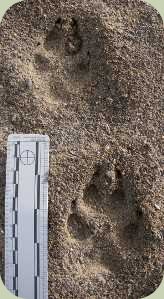
Tracks: Coyote footprints are oval-shaped and measure approximately 2.5 inches long by 2 inches wide. They register four toes with claws in both front and hind feet. Their tracks are relatively symmetrical, though they can show a slight lead toe/claw that allows left and right feet to be differentiated. Their foot pad is roughly triangular-shaped. The hind foot is slightly smaller than the front foot and registers a smaller foot pad. The photo to the right shows a hind track above a front track. |
 |
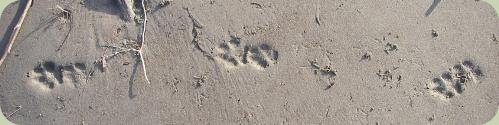
Gaits: Coyotes utilize a variety of gaits, including walking, trotting, loping, and galloping gaits. One of their favored gaits is an overstep trot, where front and hind feet on the same side of the body land close together, with the hind landing slightly ahead of the front. These trotting gaits leave a line of tracks that is very straight and narrow. When utilizing a trot, step lengths between groups of tracks often measure from 15 to 22 inches. The picture below shows a slow trot, where each hind track has landed slightly behind the front track.
Coyote Sign
|
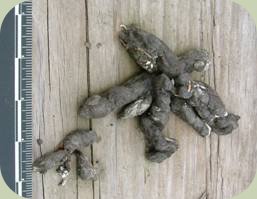
Scat: Coyote scat is often rope-like, very tapered, and spongy, with a diameter of approximately 1/2 of an inch. The contents can vary widely due to their omnivorous diet, though it is often gray-colored and filled with hair and bones of small rodents. It is usually placed in the middle of trails, dirt roads, or trail/road intersections. Latrines (places where multiple scats have been deposited) are common. Coyote scat often does not have much of a scent. |
 |
Be More Prepared For Your Next Outdoor Adventure!
Don't leave without knowing these six essential survival skills. Our free survival mini guide reveals the strategies of:
- Shelter & fire to prevent the number one cause of death
- Obtaining clean water to avoid life-threatening dehydration
- Common wild survival foods and other critical skills!

Similar Tracks: Domestic dog tracks are often mistaken as coyote footprints. Tracks of domestic dogs are generally rounder, have blunt nails, and are less symmetrical. Another feature that helps distinguish coyote from domestic dog tracks relates to the negative space between the toes and pad. On coyotes, an X-shape can be drawn in the negative space, whereas on most domestic dogs, the negative space does not form an X-shape. For comparison, pictured below is a coyote footprint (on the left) next to a domestic dog track (on the right).
 |
 |
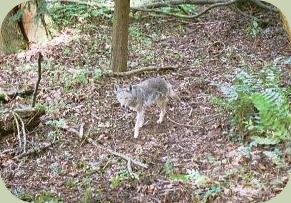 Coyote captured with a motion-sensing camera
References: Elbroch 2003, Halfpenny 1999, Murie 1954, Rezendes 1999.
Additional Resources:
Coyote Tracks - Bear Tracker's Pages
Related Courses:
Wildlife Tracking Courses at Alderleaf
By the way, when you're out tracking or looking for wild animals, it's important to know how to stay safe in the outdoors, especially if you were to get lost. Right now you can get a free copy of our mini survival guide here, where you'll discover six key strategies for outdoor emergencies, plus often-overlooked survival tips.

About the Author: Jason Knight is a cofounder of Alderleaf Wilderness College and the author of The Essential Skills of Wilderness Survival. He has been teaching wilderness skills for over twenty-five years. Learn more about Jason Knight.
Return from Coyote Footprints back to Wildlife Tracking Articles
Is The Essential Wilderness Survival Skills Course Right for You? Take the "Online Survival Training Readiness" Quiz
See for yourself if this eye-opening course is a good fit for you. It takes just a few minutes! Get your Survival Training Readiness Score Now!
Grow Your Outdoor Skills! Get monthly updates on new wilderness skills, upcoming courses, and special opportunities. Join the free Alderleaf eNews and as a welcome gift you'll get a copy of our Mini Survival Guide.
 The Six Keys to Survival: Get a free copy of our survival mini-guide and monthly tips!
Learn more
Wait. Before you leave...
Don't forget your Survival Mini Guide.
It's free.
Be more prepared for your next outdoor adventure! Discover six essential survival skills. Join our newsletter and get a free copy of the guide as a welcome gift!
Your privacy is our top priority. We promise to keep your email safe!